When did weight loss start counting in SURMOUNT-3?
The first day a volunteer joins a trial can come months before the first day its main comparison starts.
The first day a volunteer joins a trial can come months before the first day its main comparison starts. In SURMOUNT-3, people completed an intensive lifestyle program before qualifying for randomization. That changes what its frequently quoted weight-loss figure means for a reader in Bali.
Draw a line before randomization
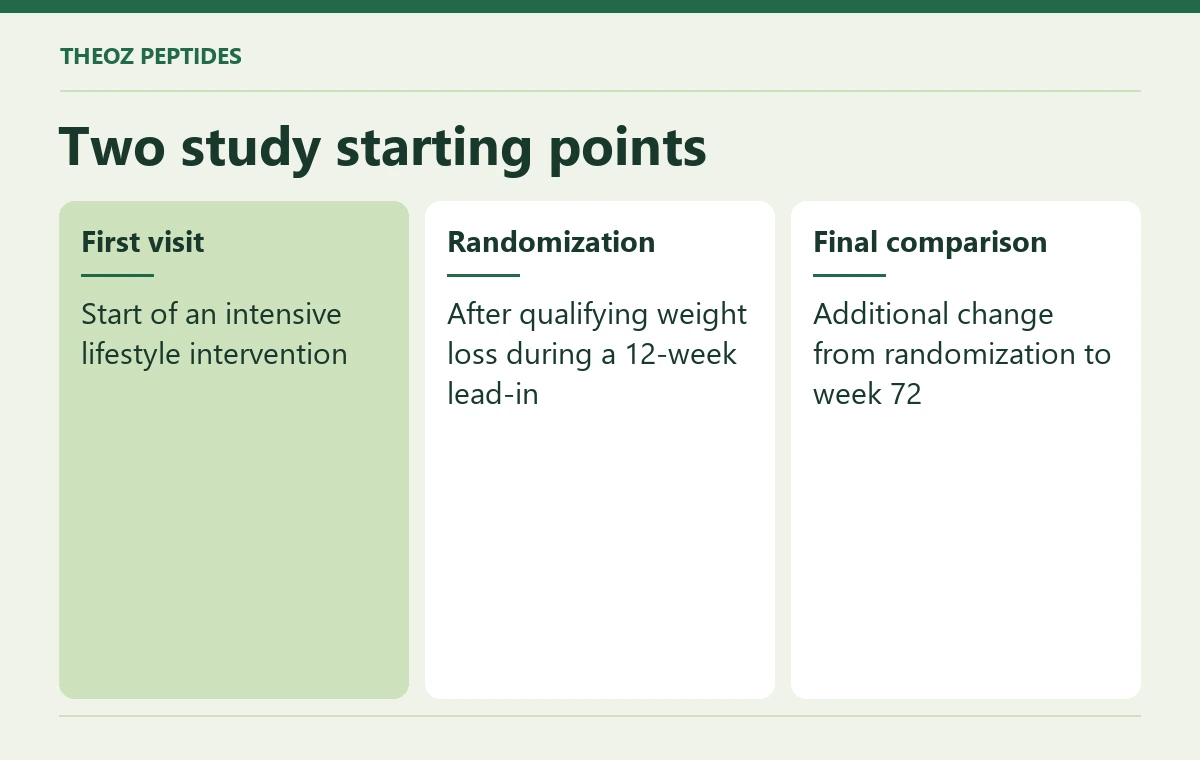
The SURMOUNT-3 report describes a 12-week lead-in. People who achieved at least 5 percent weight reduction during that phase could enter the randomized comparison. Those who did not meet that threshold were outside that comparison. The trial therefore addresses an important question about additional change among people who first responded to an intensive intervention. It does not estimate what all people beginning a new routine would experience from their first day.
Do the two percentages add?
Suppose an imaginary participant starts the lead-in at 100 kg and reaches randomization at 95 kg. Another 10 percent measured from randomization uses 95 kg as the base, giving 9.5 kg, not 10 kg. The example illustrates denominators, not a treatment forecast. When the paper reports an estimated 18.4 percent mean reduction on tirzepatide after randomization, the baseline described in that clause matters. So does the comparison with the placebo group in the same randomized phase.
| Two study starting points | What to look for |
|---|---|
| First visit | Start of an intensive lifestyle intervention |
| Randomization | After qualifying weight loss during a 12-week lead-in |
| Final comparison | Additional change from randomization to week 72 |
What the control group adds
Both randomized groups had already met the qualifying threshold. Their subsequent experiences can therefore be compared within the trial design. An uncontrolled photo taken before the lead-in and another at the end of randomized follow-up cannot isolate the medicine's contribution. If your own Bali fitness diary starts during a holiday or after an illness, record that context too. Two equally numbered “week one” entries can represent very different stages.
Keep a useful research note
Use three dates for a two-stage study: enrollment, randomization and assessment. Record who crossed from the first stage into the second and which figures use each starting point. This short note captures the main finding without turning the trial's highly selected start into a promise for a user of a local tirzepatide presentation.