Retatrutide and urine albumin: why the starting value matters
An impressive percentage can hide a small absolute change.
An impressive percentage can hide a small absolute change. This is particularly important when people begin a study with a low urine albumin-to-creatinine ratio. The exploratory retatrutide kidney analysis gives Bali readers a concrete example of why researchers report more than one number.
First read the denominator
NIDDK explains UACR and eGFR as different measurements. UACR relates albumin in urine to creatinine in the same sample, helping address urine concentration. Estimated glomerular filtration rate describes another aspect of kidney function and uses different units. An increase of five on one measure and a decrease of five on the other are no more interchangeable than temperature and rainfall on the Bali weather page.
What the investigators found
The phase 2 analysis looked separately at participants with type 2 diabetes and participants with overweight or obesity. Average baseline UACR values were relatively low in the groups studied. Some comparisons showed lower UACR with retatrutide, but the authors emphasized that the absolute reduction was modest because most people entered with normal albuminuria. The filtration findings also differed by study population. Combining the most favorable figure from each group would create a population the researchers never observed.
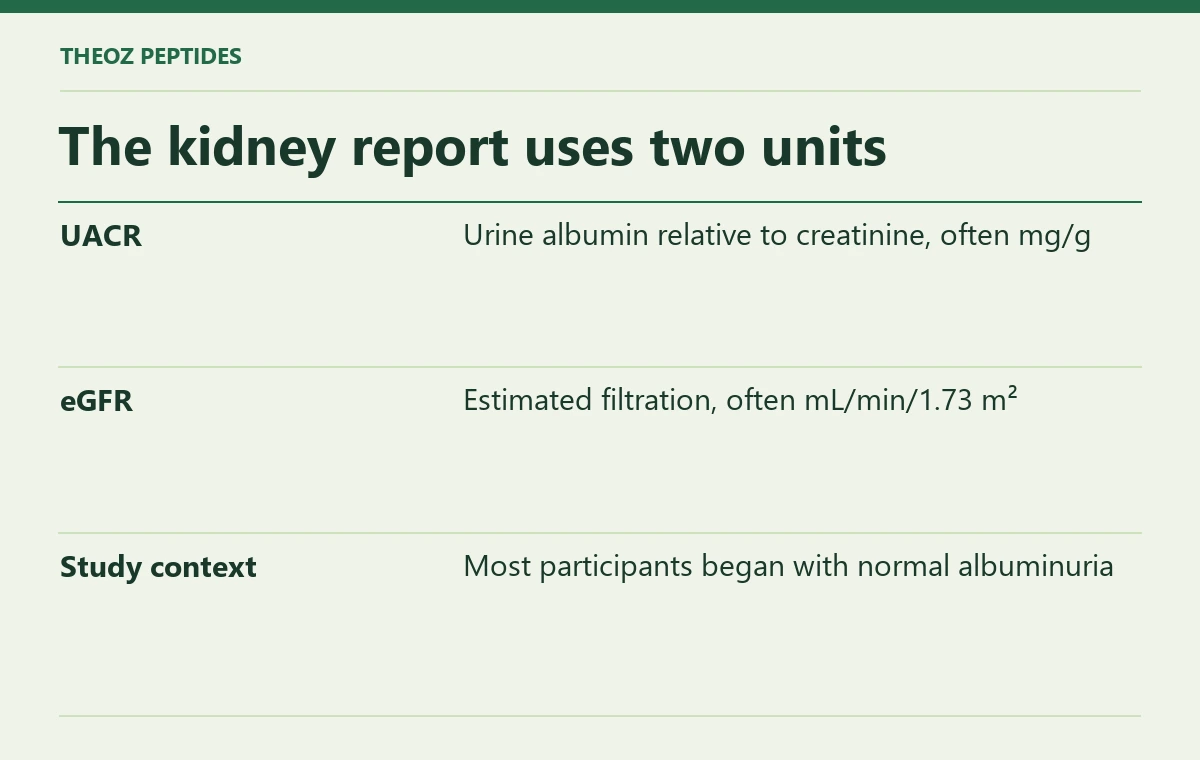
| The kidney report uses two units | What to look for |
|---|---|
| UACR | Urine albumin relative to creatinine, often mg/g |
| eGFR | Estimated filtration, often mL/min/1.73 m² |
| Study context | Most participants began with normal albuminuria |
Try the arithmetic before applying the result
An imagined ratio falling from 10 to 7 mg/g and another falling from 100 to 70 mg/g both fall 30 percent. Their absolute changes are 3 and 30 mg/g. This illustration does not reproduce a participant or set a clinical threshold. It shows why any treatment headline needs the starting value, time point and comparison group. A change versus placebo is also distinct from an individual's change from baseline.
What to ask in Bali
Take your dated lab report to the clinician who requested it. Confirm which measure and unit appear, whether the clinician needs a repeat sample and what the result adds to your own clinical assessment. The phase 2 paper describes laboratory parameters. Whether an intervention prevents future kidney failure or changes an individual's care requires different evidence from a catalogue, a UACR percentage or a product photograph.