What does SELECT tell a retatrutide reader about secondary prevention?
A headline about heart protection in people with obesity can omit the fact that participants already had cardiovascular disease.
A headline about heart protection in people with obesity can omit the fact that participants already had cardiovascular disease. It may also omit the exact molecule. Both omissions matter. SELECT investigated semaglutide and secondary prevention, while many Bali readers first encounter its results in discussions about incretin medicines generally.
What secondary prevention means
The SELECT cardiovascular outcomes trial enrolled adults with overweight or obesity and established cardiovascular disease, without diabetes. Secondary prevention seeks to prevent further events in people with established disease. Primary prevention concerns people who have not had that clinical history. Absolute event rates and applicability can differ even if two people have the same body weight. A person identified only by BMI has not necessarily met the trial's risk criteria.
Count the events actually studied
The primary composite included cardiovascular death, nonfatal myocardial infarction and nonfatal stroke. Investigators observed fewer primary events with semaglutide than placebo. These are clinical events, distinct from changes in blood pressure or cholesterol. A composite result also does not imply precisely the same relative change for each component. A chart should keep the comparator and follow-up beside the event estimate.
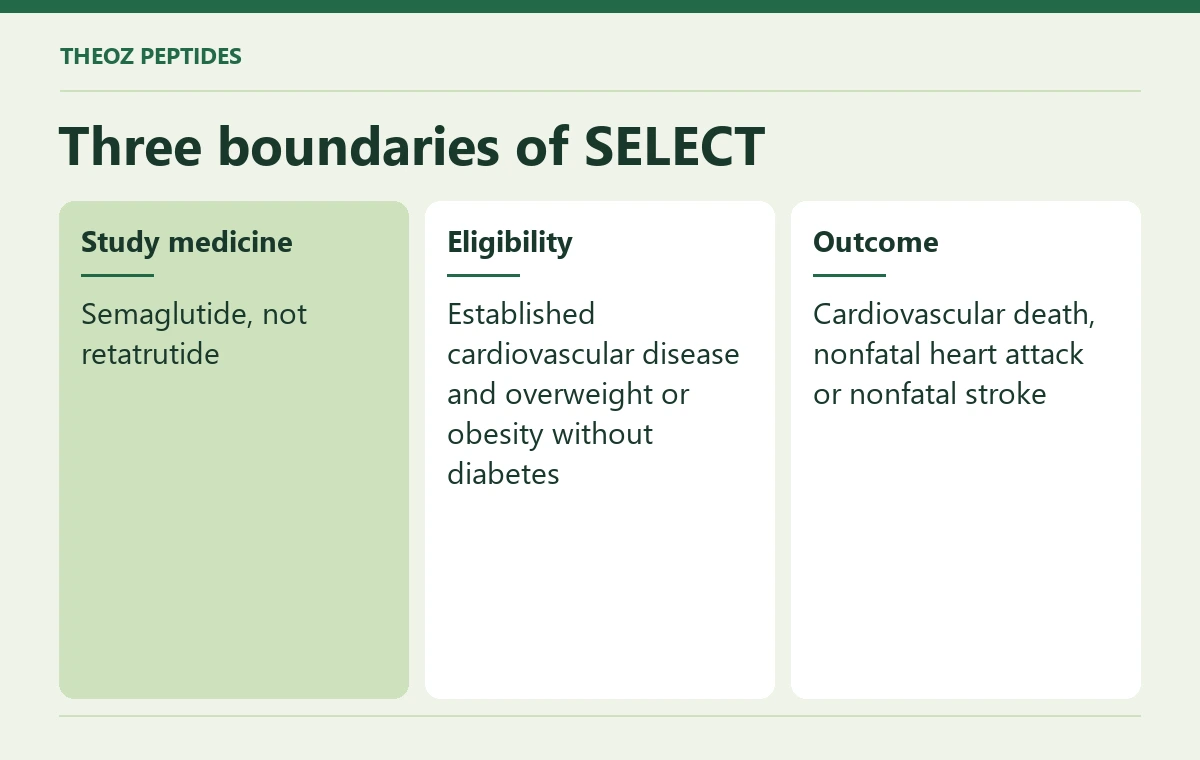
| Three boundaries of SELECT | What to look for |
|---|---|
| Study medicine | Semaglutide, not retatrutide |
| Eligibility | Established cardiovascular disease and overweight or obesity without diabetes |
| Outcome | Cardiovascular death, nonfatal heart attack or nonfatal stroke |
Where retatrutide enters the conversation
Retatrutide is a different molecule with its own clinical development program. Sharing activity at one or more pathways is a scientific reason to ask further questions, not a substitute for an outcomes trial of that agent. A trial measuring weight with retatrutide and a trial counting cardiovascular events with semaglutide cannot be combined to establish how retatrutide changes this risk in a particular population.
A question worth bringing to clinic
If cardiovascular prevention is the goal, ask which evidence matches the exact condition, medicine and existing care. Record a history of cardiovascular events and current prescribed treatments rather than relying on the broad phrase “metabolic health.” A retail catalogue may identify a Bali pen presentation. It cannot convert one medicine's trial into another's cardiovascular indication or establish that an individual is in the same secondary-prevention population.