Niacin raised HDL. Did that prevent major vascular events in HPS2-THRIVE?
The B3 family is often mentioned in discussions of NAD+ and metabolism.
The B3 family is often mentioned in discussions of NAD+ and metabolism. A large trial involving niacin illustrates an important point about biochemical reasoning: an intervention can change a lipid measurement in a favorable direction without demonstrating the benefit people hoped for on clinical events.
What HPS2-THRIVE actually tested
The HPS2-THRIVE randomized trial studied extended-release niacin combined with laropiprant in high-risk patients receiving background lipid-lowering treatment. The intervention was neither NAD+ nor nicotinamide riboside. The trial evaluated whether adding that particular intervention reduced major vascular events. Ingredient, comparator, background treatment and outcome must be retained when the research is quoted.
What happened beyond the lipid panel?
The intervention altered lipid concentrations, including increasing HDL cholesterol, but did not significantly reduce major vascular events compared with placebo. Serious adverse events were also an important part of the findings. A chart of laboratory changes alone would therefore leave out the very question the trial was designed to answer. This does not mean HDL is irrelevant to cardiovascular biology. It shows why changing a marker through one intervention does not guarantee a specific event reduction.
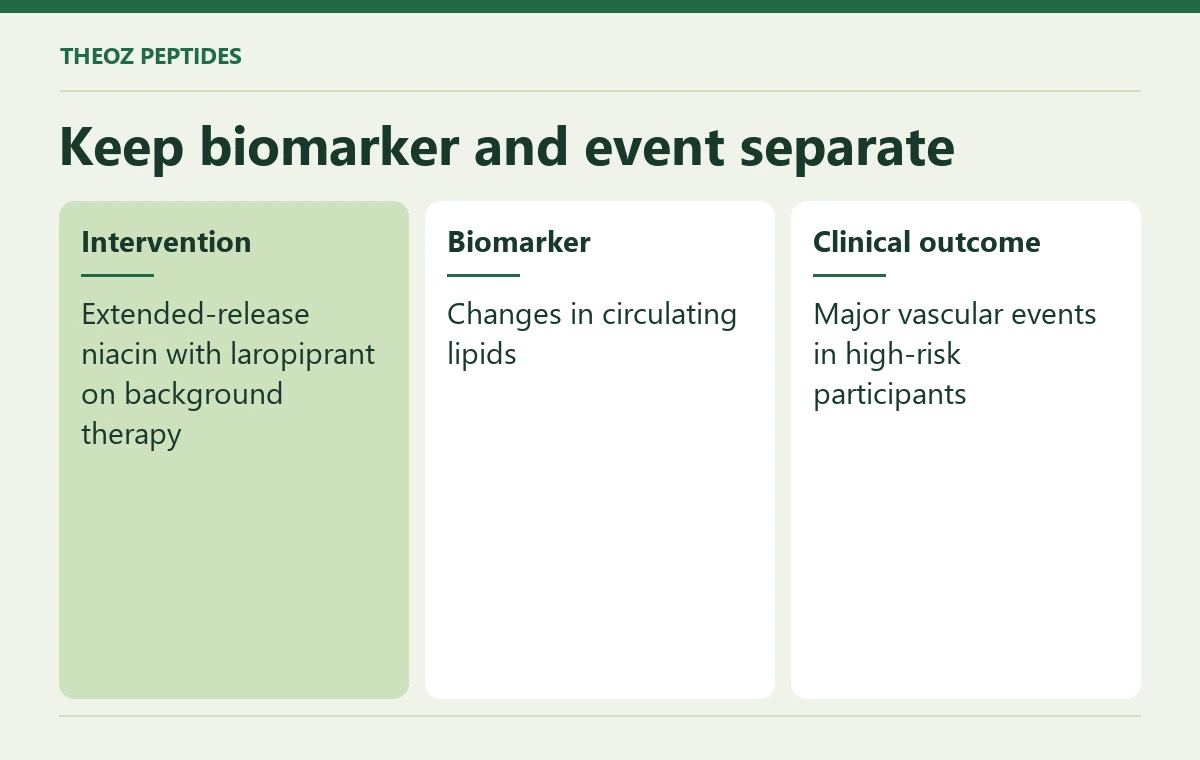
| Keep biomarker and event separate | What to look for |
|---|---|
| Intervention | Extended-release niacin with laropiprant on background therapy |
| Biomarker | Changes in circulating lipids |
| Clinical outcome | Major vascular events in high-risk participants |
Why the molecule matters
Niacin, nicotinamide riboside and NAD+ belong to related biochemical discussions but differ as administered substances. The conclusion from this niacin and laropiprant combination cannot be assigned unchanged to a retail NAD+ pen, another B3 form or an unstudied cardiovascular claim. It is equally inappropriate to use the study's lipid change to advertise NAD+ as a way to prevent an event.
How a reader in Bali can apply the lesson
If a report claims an ingredient protects the heart, ask whether the cited study counted clinical events or measured only a blood marker. Then check the participants, existing treatment, intervention, observation time and harms. A clinician can interpret the person's actual lipid values and clinical risk. The research provides a concrete way to check an argument, not a reason to start, stop or switch a medicine or supplement.
For example, a clinic can record that a person’s HDL result rose on repeat testing. To know whether an intervention prevents strokes, investigators must instead follow comparable groups and count strokes using a consistent definition. Having an exact cholesterol result for every visit does not produce the unobserved stroke count.