Can one IGF-I sample stand in for a week on long-acting growth hormone?
An IGF-I result obtained early in a treatment interval can answer a different question from one taken later.
An IGF-I result obtained early in a treatment interval can answer a different question from one taken later. This is particularly relevant for a long-acting GH preparation such as somapacitan. Research on its weekly response profile shows why a clinician needs the exact product and timing before interpreting a test brought to Bali.
What the modelling study did
The somapacitan monitoring investigators studied how a sample taken at a known time after administration could help predict mean or peak IGF-I across a weekly interval. A model is useful because repeated blood sampling throughout a week is burdensome. It is a tool derived under specified conditions, not a direct measurement of every patient's weekly average or an instruction to schedule an individual's test without the prescribing team's input.
Why a single result need not equal the mean
Imagine a marker that rises after an exposure and later falls. A value on the upward slope and the same value on the downward slope can have the same number but different timing. The highest measured value, the area under the response curve divided by time and a single mid-interval measurement need not coincide. A model can estimate the relation if its assumptions and the exact formulation fit.
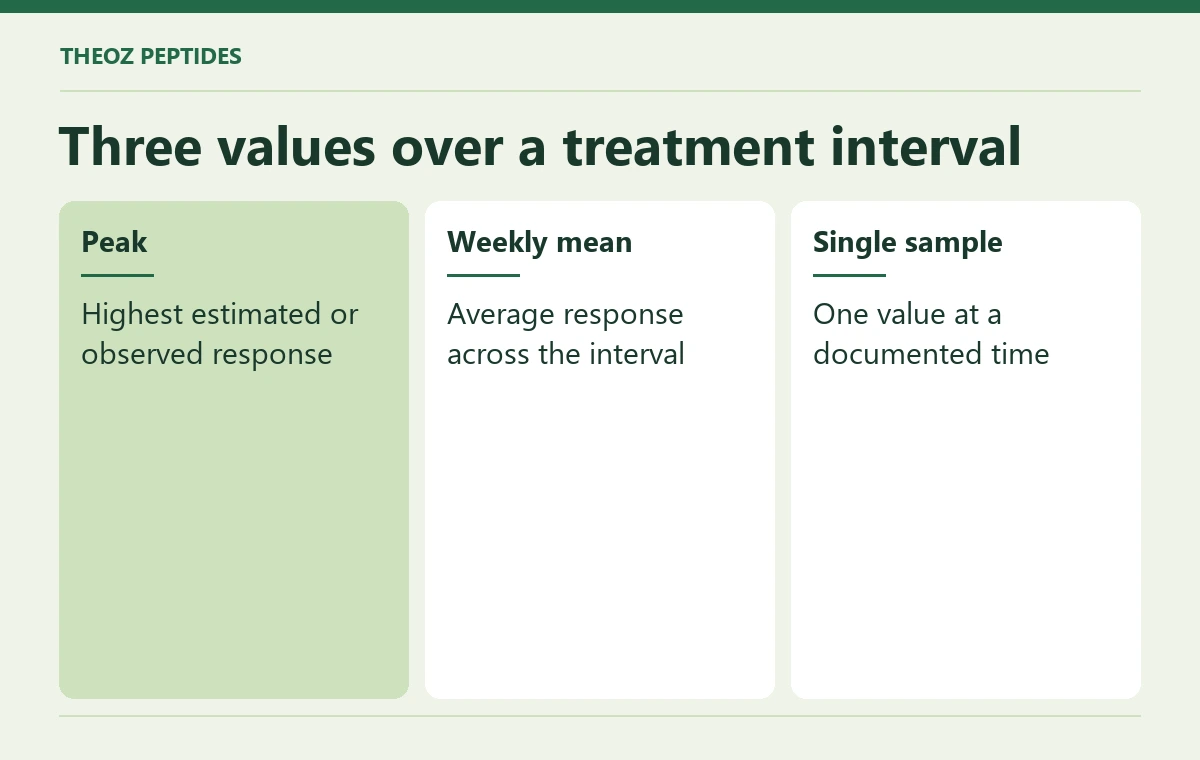
| Three values over a treatment interval | What to look for |
|---|---|
| Peak | Highest estimated or observed response |
| Weekly mean | Average response across the interval |
| Single sample | One value at a documented time |
Distinguish the preparations
Somapacitan is a long-acting growth hormone analogue. A Bali catalogue entry for somatropin identifies another preparation. Shared endocrine terminology does not make their concentration-time profiles or monitoring models interchangeable. A clinician who sees only “GH pen weekly” may not know which medicine, country label or treatment record a person is describing. Preserve the original name and supplied instructions.
A handover that supports interpretation
Bring the exact product and regimen as prescribed, actual dates of administration and sampling, laboratory method and clinical notes. If the sample was taken later than planned, record the real date rather than shifting it on paper to fit the appointment. The endocrinologist can decide what portion of the result is interpretable and whether further assessment is needed. A correctly timed, correctly identified sample is worth more than an apparently precise estimate attached to the wrong medicine.