Retatrutide results after treatment stops: which question does the estimate answer?
A patient can stop a study medicine yet remain in follow-up.
A patient can stop a study medicine yet remain in follow-up. What should researchers do with the next weight measurement? The answer depends on the question the trial promised to answer. Two analyses of the same retatrutide trial can be legitimate while estimating different effects.
What an estimand specifies
The ICH E9(R1) guidance explains a framework for defining treatment effects when events after randomization complicate interpretation. The definition includes the population, intervention, outcome, handling of relevant events and summary measure. Stopping a medicine, taking a rescue treatment and missing a clinic visit are not automatically the same issue. An observed measurement after discontinuation exists; a genuinely missing measurement does not. Those scenarios require different reasoning.
An example using one participant
Imagine someone randomized to an obesity medicine who stops it at week 20 and attends the week-40 assessment. A treatment-policy question may use the observed week-40 result according to its prespecified strategy. A hypothetical question about continued assigned treatment would need a different strategy and assumptions. The latter cannot be created by simply discarding everyone who stopped, since remaining participants can differ systematically from those who left.
| Define the question before the percentage | What to look for |
|---|---|
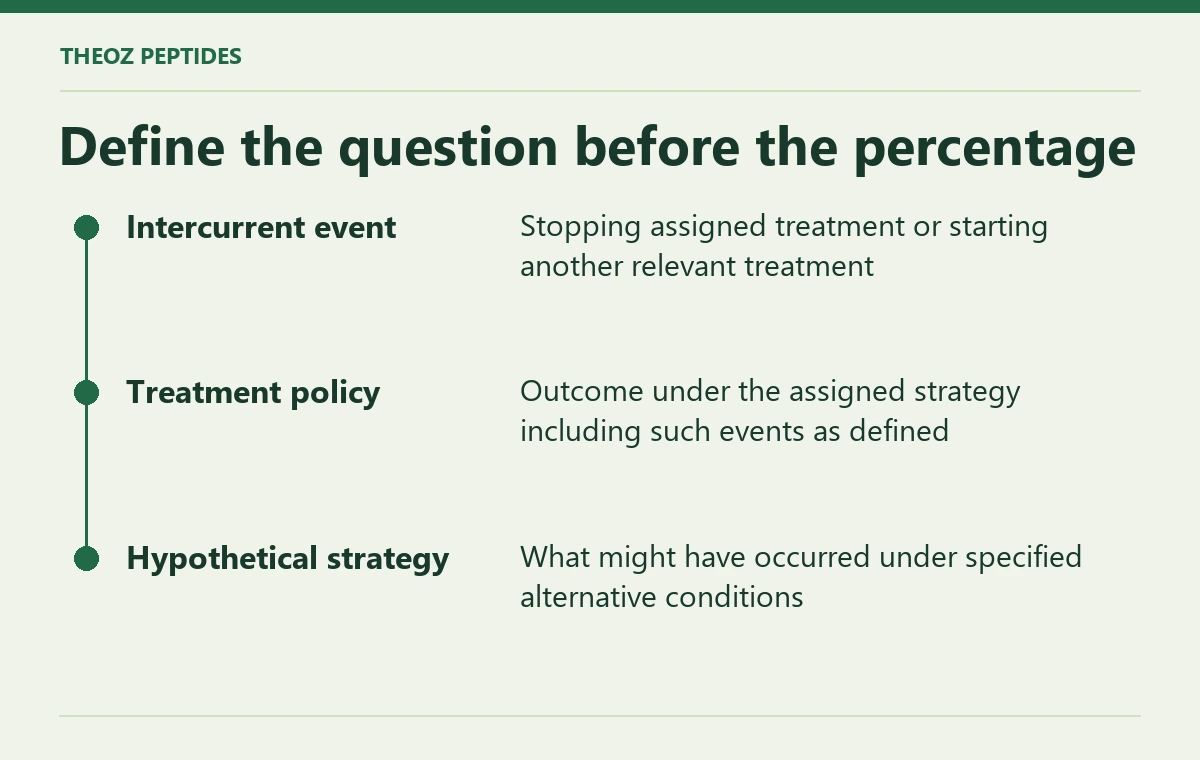
| Intercurrent event | Stopping assigned treatment or starting another relevant treatment |
| Treatment policy | Outcome under the assigned strategy including such events as defined |
| Hypothetical strategy | What might have occurred under specified alternative conditions |
How to read a retatrutide publication
Open the phase 3 obesity report and inspect the methods, supplement and captions accompanying a headline estimate. Identify the scheduled visit, which treatment changes the analysis addresses and how missing outcomes were handled. Avoid lifting a figure from a slide labeled “efficacy” and presenting it as the expected experience of every person who starts treatment. The difference between estimates can be informative rather than a reporting error.
What it means for a Bali reader
One person may ask what happens under usual difficulties continuing treatment; another may ask what was observed or estimated under continued therapy. Neither question is resolved by a pen's labelled total. Bring the trial's exact estimate and your practical concerns to the treating clinician. Stating which question a percentage answers is more honest and more informative than choosing the largest result on the page.